

Articles
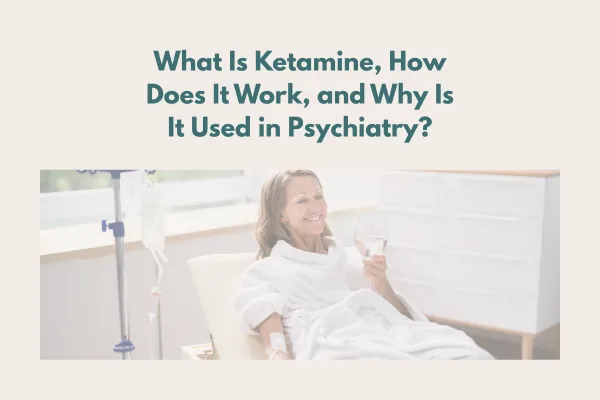
What Is Ketamine, How Does It Work, and Why Is It Used in Psychiatry?
What Is Ketamine, How Does It Work, and Why Is It Used in Psychiatry?
Ketamine is one of those topics that tends to raise a lot of questions—partly because it’s been around for decades, partly because it doesn’t fit neatly into the category of “typical antidepressants,” and partly because it works in a very different way than most people expect.
So let’s slow it down and walk through it clearly: what ketamine is, how it actually works in the brain, and why psychiatrists are increasingly using it as a treatment tool for certain mental health conditions.
What ketamine is (in plain language)
Ketamine is a medication originally developed and widely used as an anesthetic. In hospitals, it has been used for decades in surgery and emergency medicine because it can safely reduce pain and alter consciousness.
In psychiatry today, ketamine is used in much smaller, carefully controlled doses to support mental health treatment—especially for people dealing with depression that hasn’t improved with traditional approaches.
So at its core, ketamine is not “new.” What’s new is how we are using it.
A simple way to think about it is this:
In surgery → ketamine is used to safely disconnect awareness from pain
In psychiatry → ketamine is used to help “unstick” rigid brain patterns
Same medication. Different goal.
How ketamine works in the brain
To understand why ketamine is different, it helps to understand what most antidepressants are trying to do.
Traditional antidepressants often focus on neurotransmitters like serotonin or norepinephrine. The idea is to gradually adjust chemical signaling over time so mood can stabilize.
Ketamine works differently.
Instead of slowly nudging brain chemistry, ketamine primarily affects a system in the brain called the glutamate system, specifically the NMDA receptor. Glutamate is one of the brain’s main communication chemicals—it’s involved in learning, memory, and neural signaling.
Here’s the simple version:
Ketamine temporarily changes how brain cells communicate, and in doing so, it seems to “loosen” rigid thought patterns and increase something called neuroplasticity.
A helpful metaphor for what’s happening
Think of your brain like a network of hiking trails.
Every thought you think is like walking a path. Over time, frequently used paths become deep, clear trails. Less-used paths become overgrown and hard to access.
In depression, certain trails become so well-worn that your brain defaults to them automatically:
“I’m stuck”
“Nothing will change”
“This is just how I am”
Ketamine doesn’t erase those trails. Instead, it temporarily softens the ground and reduces the automatic pull toward the usual path.
This gives the brain a rare opportunity:
It can step off the old trail and explore new routes.
What neuroplasticity actually means
You’ll often hear that ketamine increases neuroplasticity. That sounds technical, but it’s actually a simple concept:
Neuroplasticity = the brain’s ability to change, adapt, and form new connections.
When neuroplasticity is low, people often feel stuck in the same thoughts and emotional patterns.
When neuroplasticity increases, the brain becomes more flexible—more able to learn, reframe, and shift.
A useful analogy:
Low neuroplasticity = a frozen landscape where nothing moves
Increased neuroplasticity = thawing ground where new paths can form
Ketamine appears to create a temporary “window” where the brain is more open to change. What happens during that window—therapy, reflection, new behaviors—can influence longer-term outcomes.
Why ketamine causes dissociation
One of the most unique effects of ketamine is dissociation, which simply means a sense of separation from usual thoughts, emotions, or surroundings.
People sometimes describe it as:
Watching their thoughts instead of being inside them
Feeling emotionally “less entangled” in painful narratives
Experiencing a dreamlike or observational state
A helpful metaphor:
Imagine you’re normally sitting inside your thoughts, like being fully immersed in a movie. Dissociation is like stepping into the projection booth—you can still see the movie, but you’re no longer fully inside it.
For some people, that shift creates enough distance from overwhelming emotions to view their experiences differently.
Why ketamine is used in psychiatry
Ketamine is primarily used in mental health care for conditions like:
Treatment-resistant depression
Severe depressive episodes
Suicidal ideation in certain clinical settings
Some anxiety and trauma-related symptoms (in specific protocols)
The key word here is resistant—meaning symptoms haven’t responded well to standard treatments like therapy, lifestyle changes, or traditional antidepressant medications.
But the reason ketamine is gaining attention isn’t just because it works differently. It’s because of how quickly it can work.
Some people experience symptom relief within hours or days, compared to weeks or months with traditional medications.
That speed matters clinically, especially when someone is suffering intensely.
The real benefit of ketamine in psychiatric treatment
Ketamine is not considered a cure. Instead, it’s better understood as a catalyst.
Here’s what that means in practical terms:
1. It can reduce symptom intensity quickly
For some individuals, depression becomes so heavy that it blocks everything else—motivation, hope, even basic functioning. Ketamine can sometimes reduce that intensity enough to create breathing room.
2. It may interrupt rigid thought loops
Depression is often maintained by repetitive thinking patterns. Ketamine seems to temporarily disrupt those loops, making it easier to access new perspectives.
3. It increases openness to therapy
When the brain is less “locked” into fixed narratives, therapy and reflection can sometimes become more effective. It’s not that ketamine replaces therapy—it may help the brain become more receptive to it.
4. It creates a “window of change”
Because of its effects on neuroplasticity, ketamine may create a temporary period where the brain is more adaptable. What you do during that window matters.
This is why integration (therapy, journaling, behavioral changes, support) is such an important part of treatment.
5. It offers a different pathway for people who haven’t responded to other treatments
Not everyone responds to traditional antidepressants. Ketamine provides an alternative mechanism—working through glutamate and neural connectivity rather than serotonin alone.
That alone is significant in psychiatry, where many conditions are complex and multifactorial.
Important context: ketamine is not a stand-alone solution
Ketamine can be powerful, but it is not designed to function in isolation.
It works best when paired with:
Clinical supervision
Psychotherapy or coaching
Lifestyle support (sleep, nutrition, movement)
Emotional integration after treatment
Without that structure, the benefits may be temporary or less stable.
A simple way to think about it:
Ketamine may open a door—but what you do in the room beyond that door is where lasting change happens.
Final thoughts
Ketamine is not a “new miracle drug,” and it’s not a shortcut around the complexity of mental health.
What it is, is a different tool—one that works on brain systems involved in learning, flexibility, and adaptation rather than slow chemical adjustment alone.
For some people, especially those who have felt stuck for a long time, that difference can matter.
Because sometimes the challenge in healing isn’t just knowing what to do—it’s becoming mentally and emotionally flexible enough to do something different.
And that is where ketamine may have a meaningful role in modern psychiatry: not as an endpoint, but as a way of helping the brain become open to change again.
Is ketamine right for you?
If you’re wondering whether ketamine therapy might be appropriate for your situation, The Journey Within can help you explore your options in a thoughtful, clinically guided way.
You don’t have to figure it out alone—and you don’t have to decide based on internet research or guesswork. A clinical conversation can help determine whether this approach fits your history, symptoms, and goals.
To learn more or schedule a consultation, you can reach us at:
Call: (801) 477-4368
Text: (801) 477-0415

Our Mission
Our goal is to help guide you through your personal Journey Within, moving you towards healing, acceptance, and relief.
Treatments Available for:
Major Depressive Disorder
Treatment Resistant Depression
Post-Partum Depression
Anxiety
Suicidal Ideation
PTSD/Trauma
Obsessive Compulsive Disorder (OCD)
Autism Spectrum Disorder (ASD)
Accepted Insurance:
Select Health (except Signature network)
PEHP
United Healthcare
UMR
Blue Cross Blue Shield
Aetna
Cigna
EMI
Tricare
Pricing List
New Client
New Client Consultation | $275 |
Vitamin IV Therapy Consultation | $275 |
Existing Client
Follow up visit - 30 minute | $175 |
Follow up visit - 60 minute | $250 |
Ketamine Assisted Psychotherapy IM (2 hours) | $350 |
Ketamine Assisted Psychotherapy IV (2 hours) | $400 |
Psychotherapy add-on to Ketamine Treatment |
|
30 minute | $75 |
45 minute | $110 |
60 minute | $150 |
Vitamin IV (60 minute) | $111 |
Vitamin injection |
|
Single injection | $30 |
Additional injections scheduled same day | $25 each |
5 pack of injections | $125 |
First Responders/Emergency Personnel
First Responder Ketamine IM | $175 |
First Responder Ketamine IV | $250 |
First Responder Self Pay Rate | 20% off |
Ketamine Packages
6 session IM and IV w/assisted therapy (2 hours) | $1,900 |
Many services can be billed to your insurance, depending on your insurance type and plan.
Please schedule an appointment with our staff and we can give you options and quotes moving forward!



Give Us a Call
Call: (801) 477-4368
Text: (801) 477-0415
Fax: (231) 216-7963
Send Us a Message
© 2026 The Journey Within. All rights reserved.